A digital economy fuelled by real-time payments? It’s a recipe for growth and prosperity — but only if Canadians feel confident and safe when transacting.
A more connected world brings promise, but it also entails the need for vigilance, and technologically advanced systems of protection against bad actors.
In this series, we’re talking about the role Interac plays in Canada’s economy and day-to-day life as a Protector, Operator and Enabler of the country’s digital prosperity. Our previous episode in this conversation series talked about the importance of trust in technology and empowering entrepreneurship in seizing Canada’s economic potential.
In this edition, cybercrime and security expert Chris Mathers joins Mark Hines, Head of Product, Fraud at Interac, to delve deeper into the connection between security and prosperity and how Interac is pairing artificial intelligence with human intuition to safeguard our growing digital prosperity against sophisticated perpetrators of fraud.
Read on to learn more about how we’re using our central place in the economy to protect Canadians, and listen to the full audio of Mark and Chris’s conversation here.
Digital fraud: an ever-evolving threat
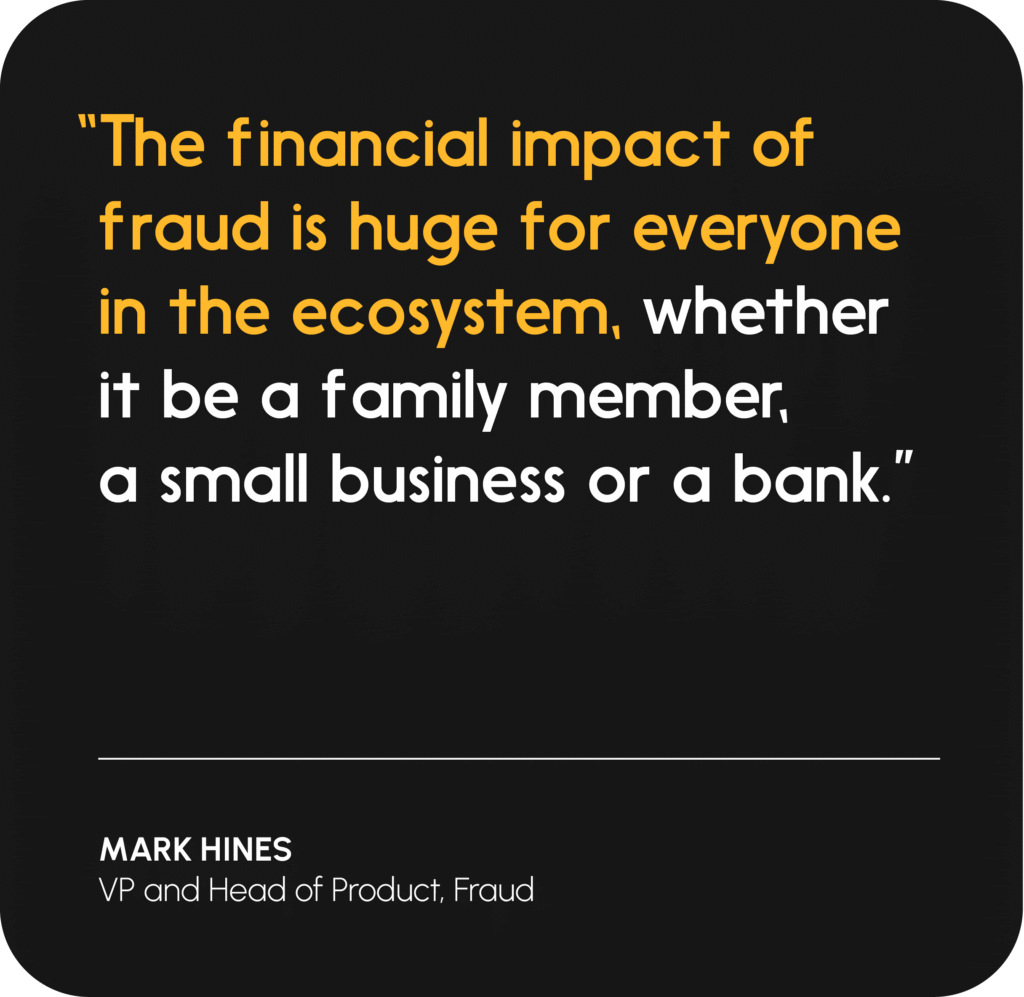
Mark Hines: The financial impact of fraud is huge for everyone in the ecosystem, whether it be a family member, a small business or a bank. What’s your perspective on risk and protection now that we’re moving to a truly digital age?
Chris Mathers: We’re under attack every single day. The financial institutions and the government are being hit with thousands of attempts every hour to penetrate their systems. It’s relentless.
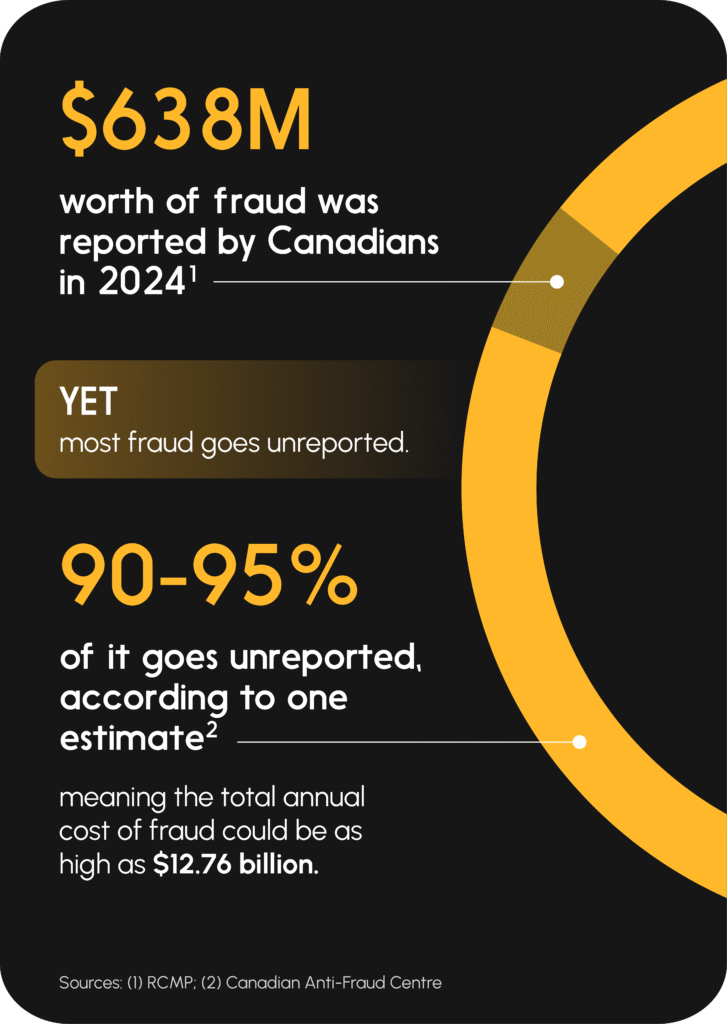
Technology is allowing criminals to reach their victims in a more unique and personal way. And typically, it comes from the other side of the world, which makes it even more challenging, because how do you enforce it when the perpetrators are in a different jurisdiction?
Mark: Few people have seen the inner workings of organized crime like you have. What has your experience taught you about the evolution of cyber threats?
Chris: Most of the scams that you see are not happening because there’s some hole in the security of our financial infrastructure. Most of the scams you see are because people have been tricked.
The entrepreneurial nature of organized criminal groups is absolutely remarkable and immeasurable. It is just fascinating how they prey on human behaviour. Even using all of the technology, it’s still preying on the weak link, which is humanity. [When there’s a] $100,000 real-time payment fraud, somebody made a mistake somewhere [rather than a system error.] Somebody got tricked. That’s how it goes every time.
Curiously, the point I always make when I’m speaking about this is that there are no new crimes. What we’re getting is old-school crimes dressed up and being delivered to the consumer using newer technology.
Comfortable, educated consumers will fuel growth
Mark: Overall, these things mean that people are more cautious when they’re trying to do things on digital platforms, which is precisely the inverse of what we’re saying we need to happen to get the economy growing.
Chris: In order for people to embrace this whole concept of digital prosperity, they have to trust the system. I think the path to digital prosperity has to include education.
We need to constantly educate people about the threats, because the threats are changing every day. And an aging population is the other challenge; they’re a lot more vulnerable to fraud attempts.
Mark: We often talk a lot about education and it feels a bit fluffy and it gets dismissed because it’s not AI or big data or technology, but I think it’s key.
The phrase I like to use is, “It takes a village [to fight] fraud.” Even our biggest, most well-funded banks can only do so much by themselves because they’re one node on a network.
I really view fraud and its solutions as a network question. At Interac we have a unique view over the Canadian ecosystem, specifically money transfer and debit, that others don’t. Which is why we’re investing in fraud prevention.
We have to look at assets we have, whether it’s Interac or more broadly as a country, and we need to use them better. From an Interac perspective, we have a unique access to a lot of payment data, and we can use that to much greater effect.
Discover a better, more secure way to verify customers and streamline digital onboarding with Interac Verified. Learn more.
Protecting real-time payments
Mark: If we don’t build advanced security into a new real-time system, we are going to see those losses increase even more, which happened in a number of other countries that built a real-time payment system without sufficient fraud controls. They had to then reel back the launch of a system that’s supposed to enable growth.
When real-time comes into play, how do we protect those larger-value payments? Because it’s one thing to lose the $25 I thought I was spending to buy a cheap pair of running shoes. It’s another thing when my $100,000 mortgage down payment is lost. That is when you need a platform that you trust.
How do you think real-time payments are going to affect fraud over the next few years?
Chris: Real-time payments are a juicy piece of fruit for the bad guys. It’s an opportunity to subvert the system in a big way.
What I’ve seen anyway in the investigations we conduct is that the bad guys have become very familiar with the real time, with the payment infrastructure. They understand how, and once they become familiar with it, they’re able to see if they can drill holes in it.
Stopping fraud with AI and human intuition
Mark: Another element of the “village” required to tackle fraud is a secure central platform. And not just one; you need multiple layers in order to deal with this because the threat vectors will continue to get more sophisticated; they will simply continue to grow in scale and velocity. Which brings me to AI.
The best way to think of a fraud system is one big feedback loop. There are two important points on that feedback loop. One is the quality of the signal that we, as a fraud [prevention] provider, give to the decision maker, which is usually a financial institution or payments company that’s about to authorize a payment. And then the second one that people don’t spend enough time on is the feedback loop from that entity confirming whether or not suspected fraud is in fact fraud or is not fraud.
AI comes into that loop two ways. One is you can use AI to improve the signals that you’re giving the financial institution or the payment company. That sounds very obvious. But to dig down a little deeper into it, a lot of that work right now is what’s called rules-based, which means that it’s sort of a hard-coded decision tree. And it can be fairly effective.
But what’s way more effective is when you have a model that gets what’s called probabilistic. So, it can’t tell you for sure, but it can tell you with 95 or 98 per cent [certainty], “I think this is a scam.” [The AI system] picks up on all of these subtle patterns that exist, that deterministic rules can’t see.
Chris: The bad guys are using AI, we have to use it too. It’s teaching them how to defraud people. It’s just a war of attrition back and forth.
When you’re going to buy something from someone or selling something to someone, you want to make sure that it’s the person that they’re purporting to be. Using artificial intelligence, we can develop systems that will be… not foolproof, but close to it.
Mark: This is not a case of removing people from our cybersecurity efforts. It’s a way of upskilling everyone.
![“Human beings are always [essential] in preventing fraud.”— Chris Mathers, Cyber security expert](https://www.interac.ca/wp-content/smush-webp/2026/02/INT_Strategy-Podcast_Article-Assets_E2__Quote-1__Article_ENG-1024x872.png.webp)
Chris: AI is not the be all and end all. It really helps. But AI has no compassion. It has no sympathy. It’s just pure logic.
Because it’s human beings who are committing the crimes behind their AI systems, [only humans can listen to] that hair on the back of your neck feeling, that intuition.
Mark: Another former law enforcement person said to me, “You should use AI in the same way that an investigator would have a hunch. The system gives you an idea that you [look into], and sometimes the hunch will lead you to the bad guy. Sometimes the hunch won’t work.” AI systems work the same way. They’re not magic. All they do is process patterns.
Chris: To have a couple of good investigators or analysts, those people are just invaluable. Human beings are always essential in preventing fraud or detecting fraud.
Listen to the full audio of Mark and Chris’s conversation here.
And check out the next conversation in the series, exploring our role as an operator delivering real-time payments.



![Photo collage: Giles Sutherland, Interac, and Amanda Zeffiro, Kijiji Quote: “We could have put up more walls, but that hurts the honest users.” —Amanda Zeffiro, Kijiji Quote: "[Digital verification] will be a true uplift to the whole economy.” —Giles Sutherland, Interac](https://www.interac.ca/wp-content/uploads/2026/09/INT_In-Convo_Kijiji_Header-640x640.png)