Imagine a local snack food company has reached its newest and most significant milestone, expanding into larger chain stores. When a payment from one of those chain stores is processed, it is sent to the snack food company in minutes digitally.
These near-real-time payments are essential to the growing business’ expansion. Now the founders can sign a lease to open a bigger manufacturing facility, purchase new state-of-the-art equipment and fulfil online orders sooner. The rapid growth almost makes them forget the early days — the sleepless nights waiting for cheques to clear; having to invest their own funds to cover the difference; reconciling invoices manually; and constant worries over cash flow issues leaving them short of funds to pay for payroll and facility and equipment rentals.
When payments are circulating quickly and securely, everyone has more room to breathe, from the business owners to employees to vendors.
While this is a hypothetical example, the scenario is familiar to real businesses across Canada — especially to those that have realized the benefits of modernizing their payment solutions.
As Canadians increasingly focus on national solidarity and supporting local companies, modernizing payment systems can help accelerate our nation-building efforts. They enable companies to broaden their reach and accessibility. And developing these systems within Canada also allows us to focus our priorities on the needs of Canadian consumers and businesses.
The moment is now for an all-hands-on-deck approach between government, financial institutions and businesses to champion payments modernization for growing businesses. For leaders, it’s a time to understand the importance of modernization in helping our growing small- and medium-sized businesses (SMBs) expand and compete.
Local businesses: The engine helping to drive the economy
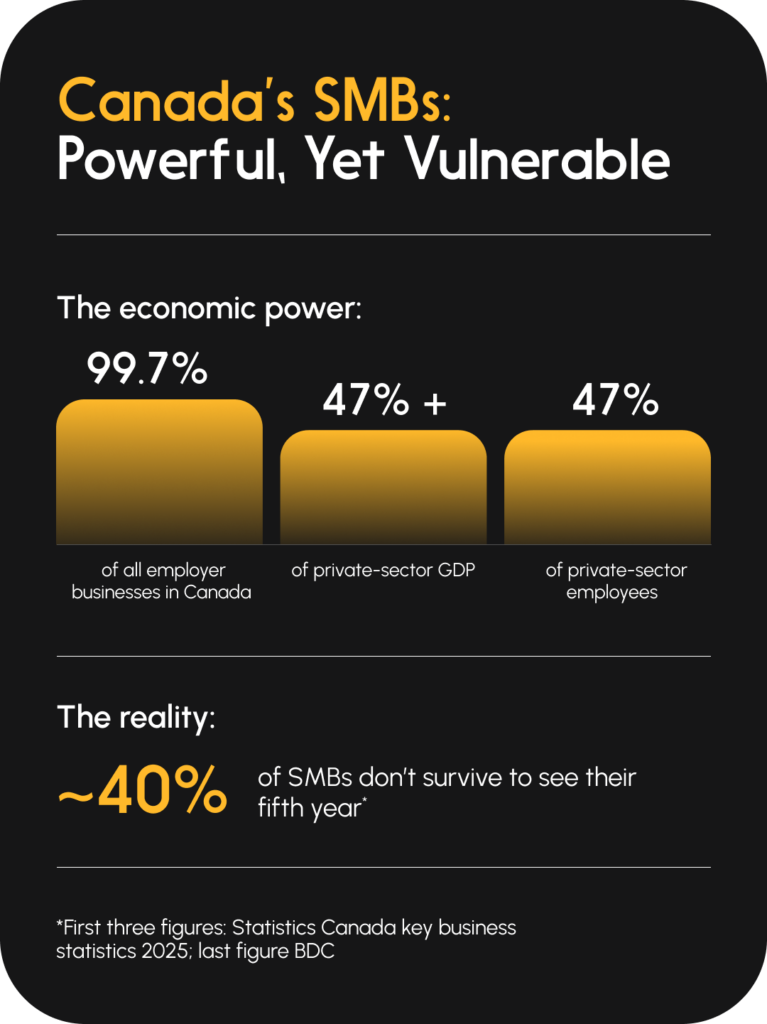
It’s become a cliché to say small- and medium-sized businesses are the backbone of the Canadian economy, but it’s true: They employed 7.9 million individuals in Canada — roughly 63 per cent of the total private labour force in 2024.
For some growing SMBs, forward momentum is stalled in part because of delays with cheques and electronic fund transfers (EFTs). Even if these businesses are profitable, they can’t always quickly and easily access money they’ve earned. And when cash doesn’t flow easily, businesses don’t hire, invest, expand or take strategic risks. The impact multiplies.
Imagine how many lives the local snack food company touches. When vendors can’t count on reliable payments, it can affect their bottom line and cause supply chain delays with other customers, impacting regional and national financial infrastructures. Routinely delayed payments can also lead to cancelled contracts and expansions, and even employees reining in their personal spending if their paycheques aren’t reliable.
Simply put, when money moves slowly, the whole economy is at a greater risk of moving slowly.
Building a stronger economy one transaction at a time
Thankfully, a national conversation to advance innovation in payments modernization is underway. Sixty-five per cent of Canadian business leaders polled by KPMG say we need modernized financial services, viewing them as essential to a resilient economy.
Canada’s payments infrastructure is a strategic national asset. A robust real-time payments infrastructure can stimulate a growing business, which in turn helps power a region’s economy. According to the Canadian Federation of Independent Business, 66 cents of every dollar stays in the local economy for every dollar that Canadians spend at a growing local business.
At the same time, the Business Development Bank of Canada (BDC) estimates that Canada could add 14 per cent to its GDP, about $350 billion a year, if every small and medium-sized business used digital technology the way most advanced ones already do. Another BDC research study showed that digitally advanced businesses grow faster, are more resilient and are more likely to export. The BDC also recommends that Canadian companies buy more Canadian tech, because it supports business growth, creates jobs and strengthens the economy.
How homegrown payments help build this future
At Interac we’re building tools right here in Canada that will help growing SMBs modernize their payment solutions. Interac solutions operate on Canada’s secure banking rails and give growing Canadian businesses near-real-time access to payments. Interac e-Transfer for Business helps optimize payments for organizations, allowing them to send higher-value digital transactions quickly and securely.
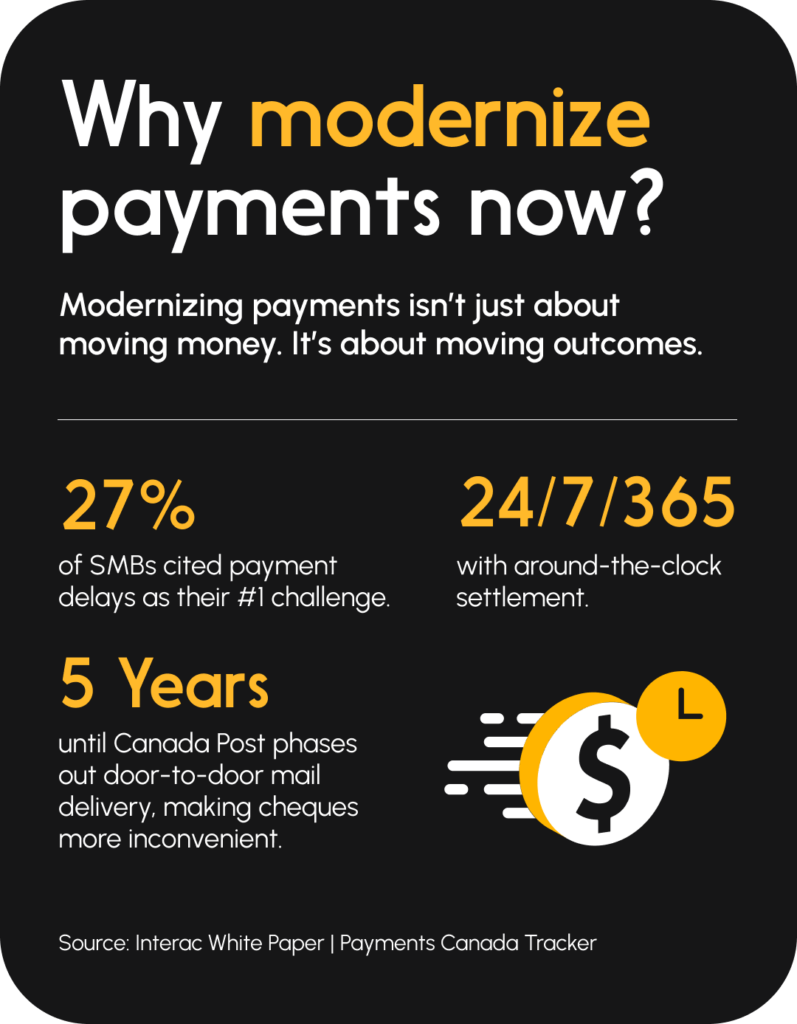
Meanwhile, Payments Canada is set to launch its Real-Time Rail payments system to support products and services that will provide secure, convenient and fast payments. (Interac is the exchange solution provider for the Real-Time Rail.)
Whichever domestic payment rails businesses are using, they help keep money from leaving Canada, transaction by transaction. Right now, half of card spending in Canada flows through foreign networks. Fees often range between 2 and 5 per cent for each transaction moving through non-domestic card rails. A portion of those fees leaves Canada altogether, instead of supporting Canadian institutions or the Canadian economy.
Data on what Canadians buy, when, how much, and from whom also travels outside our borders via foreign-owned networks. It’s a significant transfer of value from Canadian businesses.
Digital sovereignty is more than just processing transactions; it’s protecting the integrity of how value moves through this country. Backing homegrown solutions will strengthen Canada’s digital sovereignty, keeping more data and identification verification under Canadian control.
Financial sovereignty by design
At a time of economic uncertainty for Canada, reducing operational friction and improving efficiency remain important priorities for businesses. Interac is focused on continuing to build and improve on existing infrastructures and solutions that support Canadian institutions and local businesses.
With competition in the global payments landscape growing, we need to give Canadian businesses more domestic choices and better value. Over the past four decades, Interac has prioritized investing in and creating digital payments systems that are built by Canadians around Canadian needs — modernizing our tools with every technological innovation.
Remember the flexibility our local snack food company had when cash flowed seamlessly into their accounts? Now imagine hundreds of thousands more growing SMBs with the same opportunities. Let’s create more success stories. Let’s continue building systems that keep our domestic businesses competitive, our communities thriving and our economy self-reliant.
Businesses across Canada are retiring inefficient cheques thanks to Interac e-Transfer for Business.