Every month, Kijiji, a leading peer-to-peer Canadian online marketplace, reports that around five million Canadians buy and sell on their platform, with more than four million live listings across categories from automotive and real estate to furniture, phones and everyday household items.
Most of those transactions happen between strangers. While ratings and reviews help build some trust, they can’t verify whether the account on the other end of the transaction belongs to a real person. Interac Verified is designed to help address that gap, letting Canadians who bank at participating financial institutions verify their identity quickly and securely through the banking login they already use — built on the same trusted network their financial institution relies on.
In April 2026, Kijiji introduced the Kijiji verification badge, with verification powered Interac verification service (part of the Interac Verified suite of services) to add an additional layer of trust and confidence to peer-to-peer interactions. Since then, Kijiji has further expanded its use of Interac Verified: It now allows users to verify themselves with Interac document verification service by uploading their accepted ID and taking a live selfie.
Interac spoke with Giles Sutherland, Head of Business Development at Interac, and Amanda Zeffiro, General Manager of Kijiji Canada, to talk about the collaboration and what it signals for the future of digital trust in Canada. Below is an edited version of their conversation.
How digital verification builds consumer trust
Let’s talk about the origins of this collaboration. What was Kijiji looking for?
Amanda: Ultimately, it’s trust. One our key priorities under trust was around identity. We believe [an enhanced identity verification feature] could make Kijiji one of the most trusted marketplaces in Canada.
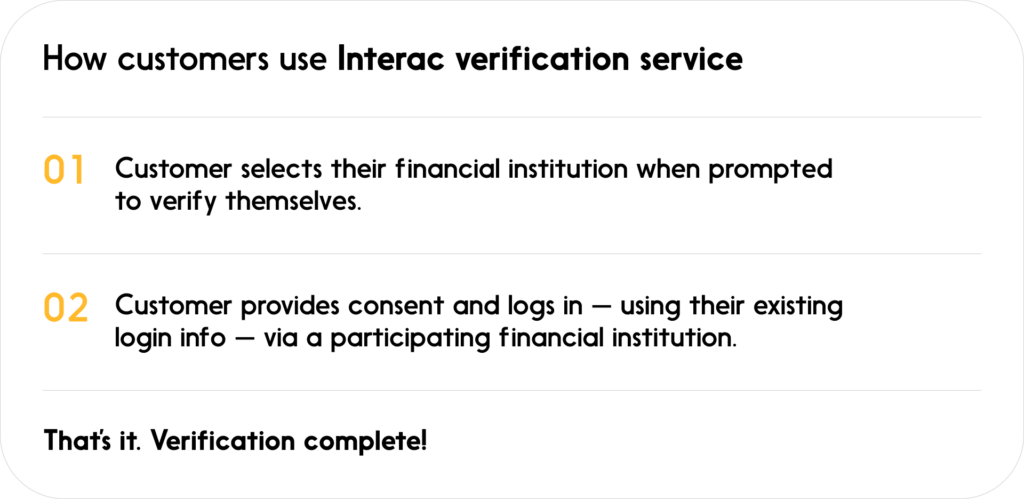
Platforms that are built on social networks build trust through familiarity — you can see mutual friends and that makes you feel comfortable. We believe that verifying with your participating financial institution by logging in with your online banking credentials is much stronger than “we have a friend in common.” And especially with our higher-value categories — autos, real estate, collectibles, high-value electronics — that only works if people feel we’ve added a layer of confidence before they make a decision of that magnitude.
Giles: The anonymity [of peer-to-peer online marketplaces] is a huge part of the challenge and risk function that people are trying to manage.
For example, if I like the bike that you’re selling, we’ll exchange, and most of the time that works. But without knowing who’s on the other side of the transaction, there’s always a risk. If you’re a fraudster and I send money and lo and behold, the bike never shows up, I’m now a victim of a scam.
Amanda: We could have put up more walls to prevent the scammers or non-trustworthy users to interact on Kijiji, but then that just hurts the honest users. So, this flips that dynamic: It empowers the honest users by enabling them to verify themselves with Interac Verified instead.
What was the solution Interac was able to offer Kijiji for the trust issue, and how does it work?
Amanda: Integrating the Interac verification service into the Kijiji platform allows users to verify their identity through the participating Canadian financial institution they already use. Users’ bank login details stay private. Neither Kijiji nor Interac has access to that information. Basically, we look to the Interac verification service to enable users to verify information using credentials associated with their participating financial institution. And once the user is verified — which is free and it takes about two minutes — that will show up as a badge on their profile, and that’s what other users can see.
How does verifying sellers help buyers?
Amanda: It enables users to feel more confident. They know that they’re dealing with a real individual, which reduces friction, mistrust or other issues that they’re facing.
Giles: As a buyer or seller, you might say, “Oh, I feel better that they’ve given this a check mark,” especially if you know that it means the person has verified their identity with Kijiji through their participating financial institution.
What does this collaboration accomplish for Kijiji, Amanda? How will it be a differentiator for you?
Amanda: For us, trust is our product in many ways. You can have the best functionality in the world, but if the buyers and sellers don’t feel safe transacting, the platform doesn’t really fulfil its purpose.
The uptake has been a lot higher than we had initially modelled, even before actively promoting it. We take that as validation that this is something that users want and are looking for.
Verification, trust and the growing digital economy
Ultimately the issue you’re solving for is trust. Why is it such a critical issue for consumers?
Giles: Millions of Canadians are engaging in peer-to-peer transactions ever year, really requiring them to put their trust in strangers online. Frauds and scams are becoming an increasingly problematic challenge globally, and Canada has been hit harder than most.1,2
With AI, with digitization, all these things, that distrust is just increasing — where deepfakes are making it really hard for consumers to trust anything, frankly. If Interac and the organizations that work with us can inject verified identity into those moments where trust is needed most, it can make a significant difference for Canadians — and in the big picture, build up consumer trust in online experiences so they engage with the digital economy rather than shrink away from it.
What other industries do you think could use Interac Verified to create better experiences for their customers?
Giles: Industries that process very high-stakes transactions. I think about when someone is buying a house, buying a car, renting, all of those require someone to say “I trust this person.” There’s also the other end of the spectrum, when you’re verifying that you’re a human for some kind of online function, or that you’re of age. And obviously age verification is a hot topic within the Canadian political landscape.
I had to renew my mortgage recently, and so I had to go into a bank branch with a number of documents and watched someone photocopy my driver’s licence in the back room and put it in a file. There should be a better way.
The vision and aspiration for Interac Verified would be to become as well-known and familiar at a household level as, say, Interac e-Transfer. People would say, “Oh yeah, I just verified myself.” They’ll barely remember sometime years prior when you had to be doing that manually with a bunch of papers and PDFing documents and photocopying a licence and taking hours out of your day.
What could be the big-picture impact of widespread adoption of digital verification in the future?
Giles: [If verification keeps growing], I think it will prove to be a true uplift to the whole economy involving millions, if not billions, of interactions for Canadians in a given year — people going to pay their taxes, do their banking, rent an apartment, buy a car, buy something on Kijiji, whatever it is.
Telecommunications
Authenticate new account holders quickly and securely to facilitate onboarding.
Financial services and wealth management
Facilitate the opening of new accounts online, to help streamline credit approvals.
Insurance
Authenticate customers quickly to facilitate onboarding, while combating the persistent threat of fraud.
Lottery and Gaming
Help streamline customer verification and onboarding, while supporting compliance requirements and user confidence.
Retail
Authenticate for online transactions. Streamline user experiences for registration, authentication and payments.
Amanda: If businesses can instil that confidence in users to be able to contribute to the digital economy and Canadian commerce, that’s great for them.
[As Giles mentioned,] scams are more sophisticated. There is just a lot of noise now, especially with AI and everything. And if more companies adopt this verification, I think it compounds that confidence across the whole digital economy in Canada. With that greater confidence, you have Canadians that are more willing to spend money — and that creates more economic value. Everyone benefits.
How can your organization use Interac Verified solutions?
Here’s what it can enable, across sectors:
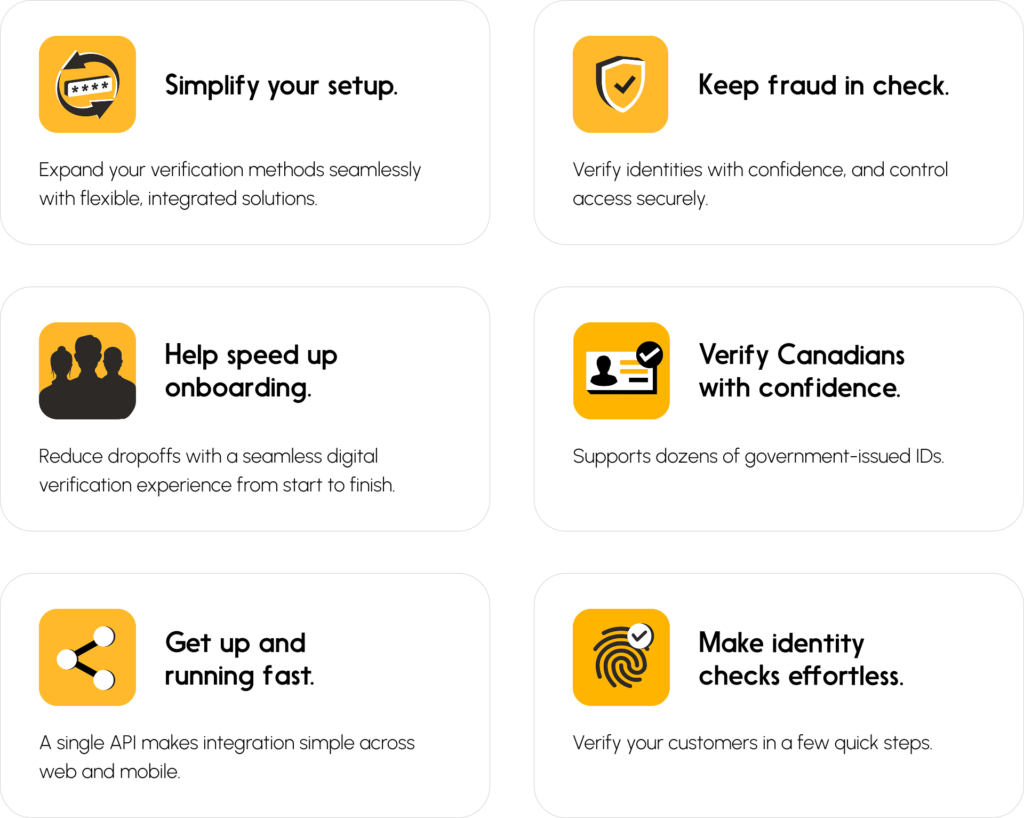
Kijiji’s verified badges mean that verification has been completed using Interac Verified.
How could your organization capitalize on it?