
Trust is often described as invisible infrastructure — we rely on it constantly, and often only notice it when it breaks.
Global cooperation has historically rested on shared assumptions: That rules would be honoured, institutions respected, and long‑standing partnerships grounded in mutual trust would endure. Today, those foundations are being challenged in ways few could have foreseen even a few years ago. The consequences are still coming into focus, but it’s clear that protecting our prosperity will depend on whether we can put some serious actions into practice to protect Canada as a sovereign country — which could include safeguarding our digital sovereignty.
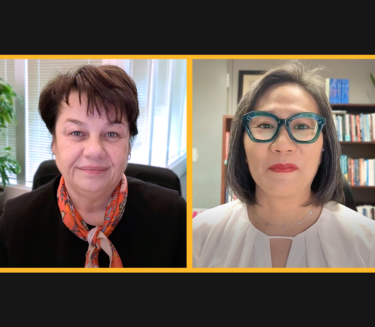
Welcome to Everyday Trust, a series of conversations I host with leading Canadian thinkers to explore the ways mutual trust will underpin the future of the digital economy. For this latest episode, I sat down with someone else who’s been dwelling on the same questions. John Ruffolo is the founder of OMERS Ventures, managing partner at Maverix Private Equity, and one of Canada’s clearest voices on innovation and economic competitiveness. We spoke about what digital sovereignty really means, and what Canada needs to do about it now. At Interac, given our position in the heart of the innovation ecosystem, I’m especially keen to discuss how technological creators and innovators can navigate a world of declining international trust.
My conversation with John was stimulating, timely and, despite everything, optimistic. Here’s what stood out.
1. Trust under a shifting world order
When free-trade rules started dissolving it destabilized the whole post-war architecture — a rules-based arrangement underwritten by shared self-interest and military alliances, which most Canadians grew up with.
“Now no one trusts each other, because everyone’s out for their own interests. And now we’re seeing why the concept of trust is so critical, even amongst the nations,” John said.
John noted the implications for our data. If other countries have access to Canadians’ data in a dog-eat-dog world, is that a threat to our digital sovereignty? He suggested the response shouldn’t be isolationism. Sovereignty is about control: the ability to set our own rules and rely on our own systems.
It’s become clear to me that this isn’t a hypothetical argument anymore. The upshot for Canada is that we have to explore bold and decisive options for safeguarding our independence and prosperity. When I’m thinking about these challenges, I like to think about it through the lens of agency. Ensuring Canadians can trust the systems they rely on and will work the way Canadians expect them to work will give us some real options when the world becomes unpredictable.
2. Building up Canada’s strengths
The energy and momentum in 2025 — the sense that this is Canada’s time to build up its competitiveness and self-sufficiency — was long overdue. Now it’s really time for us to get going.
John agrees. “We need to go into action mode, [meaning] bold action, and it’s not going to be easy. And I think the action really starts at home,” he said, mentioning a list of economic activities, from producing food to biotechnology, over which Canada should exercise sovereignty and independence.
On digital technology, does Canada have the entrepreneurial capacity here to excel and capture more opportunities? “The short answer is absolutely yes,” John said.
Yet John also echoed a sentiment that’s common among Canadian innovators and entrepreneurs: While Canada can boast of the ideas and know-how necessary to fuel a dynamic innovation sector, the capital is often lacking. What’s needed, he argued, is a targeted, purposeful funding strategy to give Canadian innovators a boost.
Before we can foster Canadian ingenuity and sovereignty, we have to know where to invest. “I do think that Canada has a fascinating abundance of resources, particularly in this space. You cannot be all things to everyone, but you can pick your spots,” John said.

“There is a true opportunity for Canadians to selectively choose the spots where we are the best in the world at it,” he said. He also suggested that Canada should explore new avenues of innovation. For example, we have the knowledge and expertise to join the elite group of countries that produce microchips.
3. Sovereignty and the ‘digital stack’
When people hear the term “digital sovereignty,” they may assume it just means hosting data (and data centres) here in Canada. John spoke about the “digital stack” to explain why that perspective is incomplete.
Think of the digital stack as a supply chain that turns data into new digital experiences. At the bottom, there’s physical infrastructure — data centres, energy, hardware and chips. In the middle are AI models (notably large language models, or LLMs) that process and generate information. At the top, we have the applications that people actually use day to day.
What are the most important parts to control, from an economic perspective? That’s the key question. John said he doesn’t think Canada needs to control every layer, but it would be helpful to know which ones could represent the greatest economic boost.
As I said to John, “Once you accept that the digital stack is strategic, it stops being a conversation about IT and becomes a conversation about national capabilities and priorities.”
4. Canada’s moment to shine in the global digital economy?
The disruption that has exposed Canada’s vulnerabilities is also, in a very tangible way, creating new openings. Countries around the world are asking the same sovereignty questions we are while looking for partners they can trust. This moment in our relations with the U.S. is challenging for Canada’s economy, but it also offers possibility and opportunity.
For some foreign countries, the answer is Canada, John says. “We are now overwhelmed by customers, particularly in the [European Union], who are seeking their own sovereignty,” he said. “Most bizarrely, we’re getting inundated with orders [from] the United States because our system is an open architecture system.”
I take this to mean that a strong, independent Canadian company or offering can be attractive to customers around the world.
I believe this is an opportune moment to name and celebrate the Canadian companies already operating at a global standard, not to take them for granted, as we so often do. I made a point of mentioning Interac, which I’m sure many Canadians don’t realize is 100 per cent Canadian, and which enables millions of people across the country to transact securely every day.
“Built by Canadians, for Canadians” isn’t just a point of pride for us. And just recently, we were once again named the Most Trusted Financial Services Brand in Canada, according to the annual Leger Reputation study. The trust we’ve built is an important asset in this shifting moment in world affairs.

I came away from my conversation with John confident that Canada can meet the challenges of 2026 and beyond. We have the talent. We have the companies. We have the values. What we need now is the will — to invest, to choose Canadian solutions. We must treat sovereignty as something that we actively shape, not that we passively inherit.
Want to listen to Everyday Trust? Check out the full episode below.


![Photo collage: Giles Sutherland, Interac, and Amanda Zeffiro, Kijiji Quote: “We could have put up more walls, but that hurts the honest users.” —Amanda Zeffiro, Kijiji Quote: "[Digital verification] will be a true uplift to the whole economy.” —Giles Sutherland, Interac](https://www.interac.ca/wp-content/uploads/2026/09/INT_In-Convo_Kijiji_Header-640x640.png)