We live in an increasingly digital-first world. That shift creates a need for Canadians to be digitally savvy. In order to adopt new technology, they have to trust it first.
But here’s the challenge: Trust can’t be assumed. It must be earned.
For Interac, fostering an atmosphere of trust is central to our role in shaping Canada’s digital future. Because trust is so critical, we’ve made Privacy by Design a guiding principle in our mission to lead Canadians to digital prosperity.
Confronting the ‘trust gap’
According to our research, 61 per cent of Canadians trust online banking security, but just 45 per cent feel confident using their banking credentials elsewhere (at third-party websites, for example). This is symptomatic of the “trust gap”, and it reveals something important: People may trust digital services in one context — like banking — yet that trust doesn’t always allow them to feel comfortable when they’re interacting with other platforms.
Concerns around data privacy are a major reason why. People are increasingly thinking about how their data is used, but privacy approaches often fail to address their hesitations and concerns. We don’t all employ the same security measures across different organizations, and that’s a huge problem. This can have economic consequences, because when trust is broken in one area, it can undermine confidence across the entire digital landscape.
What does this mean for individual organizations? Every digital product and service has to tackle privacy concerns eventually, and doing it early makes all the difference. While leaving it until later might seem easier, you’re also running the risk of consequences that will undermine the trust you’re working to build.

At Interac, we advocate for thinking about privacy from the outset of any new digital product or service. We believe digital privacy is a foundational strategic priority for earning and maintaining trust — not a compliance checkbox to tick at the end of a project.
The pitfalls of treating data privacy as an afterthought
Legal teams are often brought into projects where key decisions have already been made, teams are ready to launch, and they just need one signoff to go live. But it turns out, there may be major legal or privacy issues. When that happens, everyone has to go back several steps, reworking wireframes and the user experience. It’s costly, and it can delay implementation by months.
Treating privacy as an afterthought leads to significant consequences, including technical vulnerabilities and costly reworks that drain resources.
When organizations put data privacy on the back burner, they’re also inviting regulatory risks, reputational damage and loss of trust. And if they misuse personal information or suffer data breaches, it erodes trust across the entire ecosystem — not just for that company, but for all of us working to build confidence in the digital economy. It’s a direct impediment to innovation.
Protecting data privacy with Privacy by Design
Developed in the 1990s and 2000s by Ann Cavoukian while she was Ontario’s privacy commissioner, Privacy by Design is a smart, strategic approach to protecting people’s data.
Based around seven principles, including transparency and embedding privacy into systems and practices, Privacy by Design isn’t just about compliance. Addressing privacy early helps teams move faster and smarter, building resilience and reducing the need for late-stage fixes.
At Interac, our adherence to Privacy by Design principles directly supports fraud prevention and fuels product innovation. It significantly reduces risk by ensuring we collect only the information we legitimately need. And it empowers consumers through transparency and control.
Imagine a product development team debating whether to collect express consent or rely on implied consent. On one side, you have team members who are concerned that users will experience the consent collection as friction and will drop off the platform in response.
We would probably take the other side in the debate. Collecting express consent up front means being able to do more with the data later, within clear legal and regulatory boundaries. You can also leverage the data for insights in ways that otherwise wouldn’t be allowed.
So again, privacy can be a strategic enabler for growth, not a blocker. That’s how organizations that lead with privacy are uniquely positioned to scale responsibly and ethically. It’s a competitive advantage.
How organizations can meet emerging data challenges — like AI
Emerging technologies, particularly AI, are introducing new and complex privacy challenges. This is particularly concerning in Canada, where privacy laws haven’t been updated in over 20 years. These laws were written before the rise of social media, and they don’t reflect how data is collected, shared, and used in today’s digital landscape.
That’s why it’s critical for organizations to embed privacy from the very beginning. Doing so not only protects Canadians but also enables companies to move faster and more confidently to market.
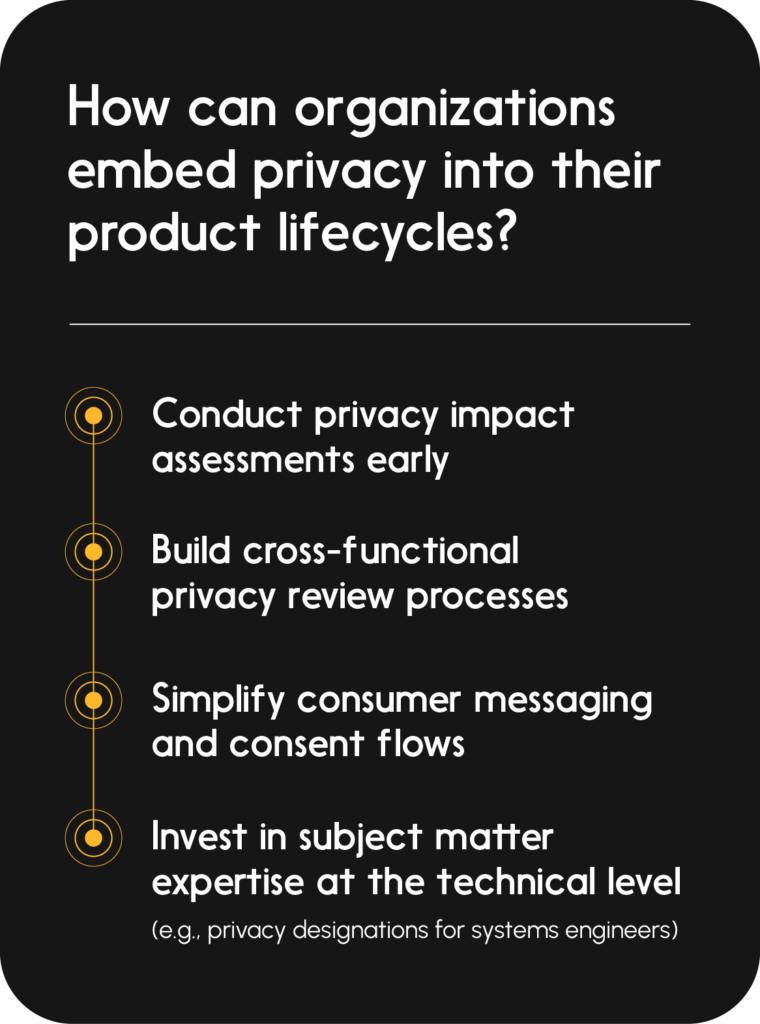
At Interac, we believe privacy is not an obstacle to innovation, but rather a powerful value driver and strategic advantage.
Ultimately, privacy builds trust, and trust builds loyalty. By making privacy everyone’s responsibility — not just the legal or the compliance team — we can build a culture of trust and bring all Canadians toward a thriving digital future.
Read Rebecca’s conversation with privacy expert Ann Cavoukian.