At Interac we’ve long predicted that the advent of real-time, account-to-account payments will transform the Canadian economy, ushering in a brave new world of greater convenience, speed and digital prosperity.
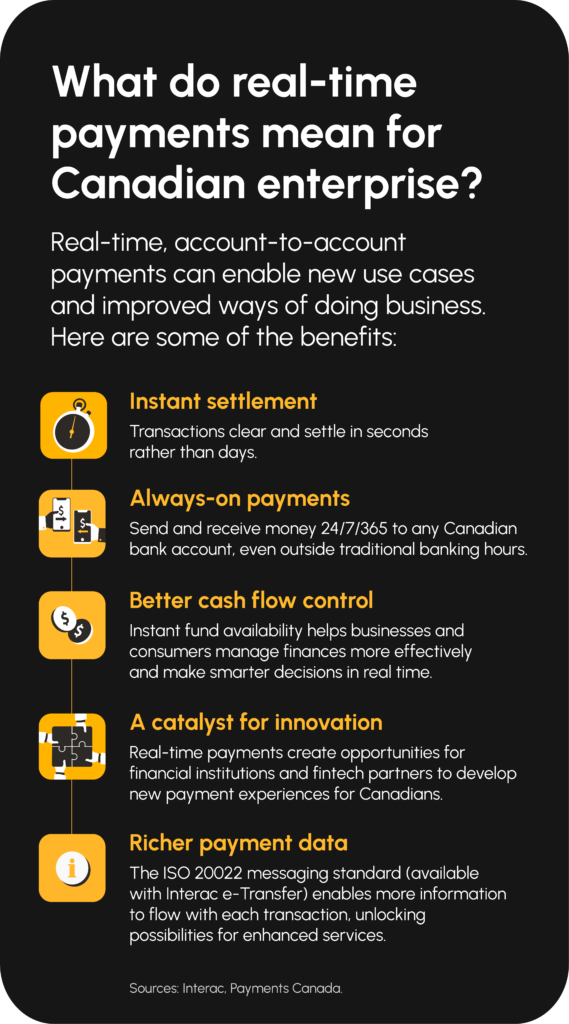
In our role as an Operator working at the centre of the economy, Interac will continue to facilitate the infrastructure for faster, modernized payments in the years ahead. Beyond offering Interac e-Transfer, we’ll also be the exchange solution provider for the coming Real-time Rail (RTR) system. Real-time payments via Interac e-Transfer for Business are already making a difference for businesses across the country. Real-time payments empower financial providers to build new products and services, leading to faster and more convenient transactions. They also give merchants faster access to proceeds — something small and medium-sized businesses tell us is critical to their success.
To talk about the changes coming up for the Canadian economy in real time, Brent Ho-Young, co-founder and CEO of Dream Payments, joined Richard Mills, Head, Client Relationships and Solution Engineering, Interac.
See below for an edited version of their conversation, and listen to the full audio here.
What is digital prosperity?
Richard: Brent, thanks for being here. At Interac, our North Star is to lead Canadians towards digital prosperity. If you had to define your vision for digital prosperity in Canada, what would it look like?
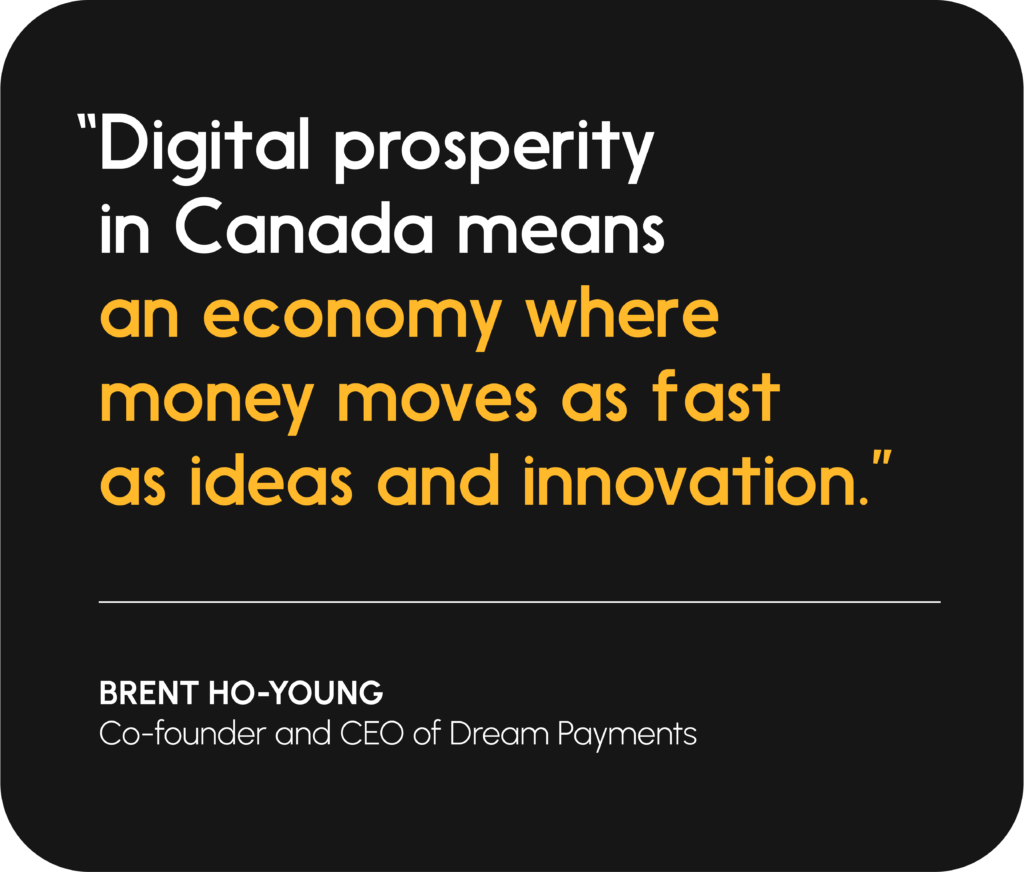
Brent: To me, digital prosperity in Canada means an economy where money moves as fast as ideas and innovation, where individuals and businesses, from the smallest entrepreneurs to the largest enterprise, have real-time access to funds; a transparent view of the data and workflows and tools that let them operate and transact with confidence.
I think it also means a Canada where homegrown technology isn’t just about participating, it’s leading.
And I think if we get this right, Canadians can feel it in fewer delays, fewer frictions, faster payments, and business will feel it, ultimately, in faster growth.
Real-time payments for real Canadian businesses
Richard: What do small and medium-sized businesses need to start thinking about when it comes to modernizing and improving the payment journey?
Brent: For SMBs, are they thinking about payment specifically, or are they thinking about building their business, growing their franchise and earning as much revenue as possible? [Because] from that lens, they really have to understand the full payment journey end to end — how that revenue is coming in, how it goes out, how do they reconcile it.
Most business owners don’t realize how much friction they’ve normalized — whether downloading CSV files from accounting tools, manually marking invoices as paid, reconciling transactions line by line. I think modernizing starts with eliminating many of those steps.
Richard: In your eyes, how can payments act not just as infrastructure, but as differentiators for businesses looking to grow?
Brent: I think payments become a differentiator when they make your business easier and maybe more trustworthy to work with.
Use cases for payments modernization
Richard: For those wishing to lead the change, what mindset shift is needed to ignite a more agile, operationally sound digital economy?
Brent: The mind shift is just looking at payments not just as a cost centre or back-office function, but as a strategic [piece of] infrastructure that determines how quickly businesses can move.
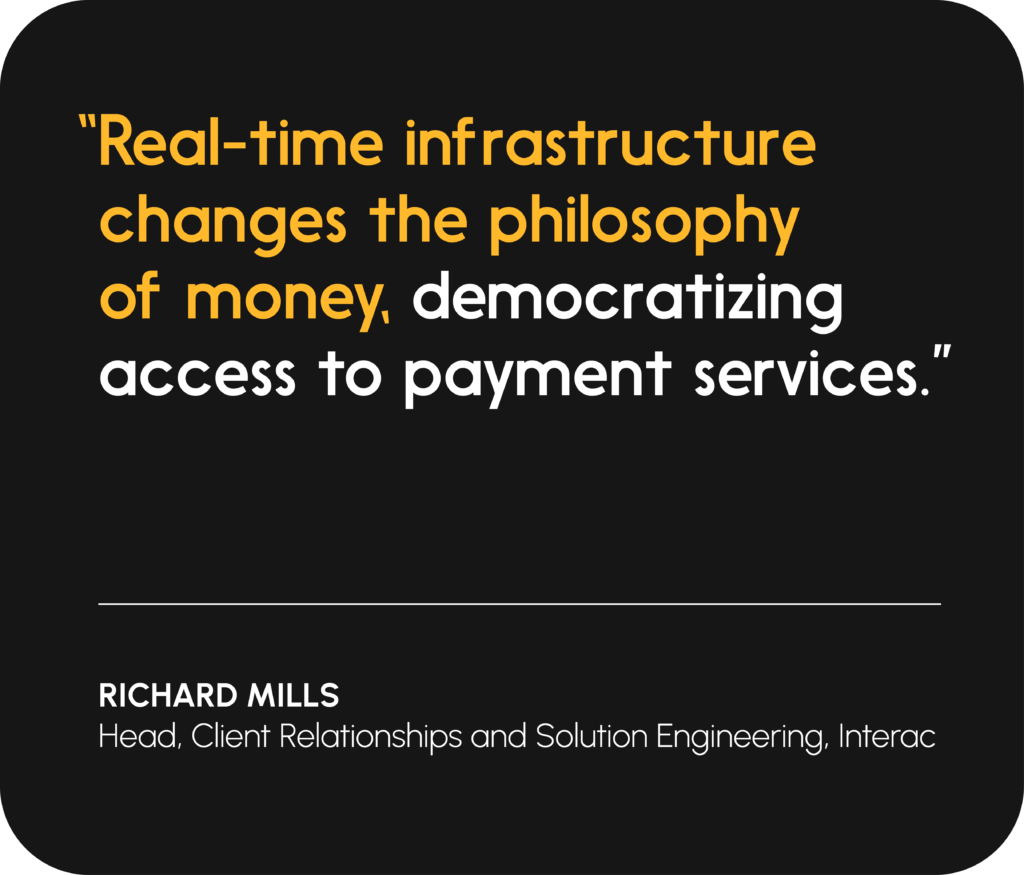
With real-time payments, you can support and activate all kinds of use cases. For gig platforms [they include] tip payouts at the end of a shift, enabling workers to receive funds as soon as that shift is complete. People have worked and they’re waiting, you know, for days or weeks for their actual payroll. Imagine allowing a server or a gig worker to access their funds in effectively real time, without prohibitive pricing or cost.
From your vantage point, how do you see faster payments unlocking new business models in Canada?
Richard: It’s massive. With the enablement of real-time payments, we could get into a situation where cash is greatly declined or eliminated, which is something that every corporate would like to see. If you ask any major treasurer, “What’s your least favourite form of payment and what is your most costly form of payment?” It’s going to be the same answer. It’s cash.
At this point, everyone is seeing cheques and paper-based payments as a huge liability for Canada.
Interac e-Transfer for Business is already powering real-time transfers in Canada
Richard: We have a near-real-time payment system already in Interac e-Transfer. Most of the time you’re sending a payment, it’s going to be in that less-than-five-second timeline that we would define as real-time, but it won’t always be.
Brent: Rich, trust has been paramount for you and your team as well. Given where Interac sits in Canada’s digital economy, how do you continue to build trust with businesses around the security of real-time payments?
Richard: One of the biggest problems with real-time payments is real-time fraud. A lot of people may not know this, but on the Interac e-Transfer network right now, fraud monitoring is going on behind the scenes for each one of those transactions.
I think we’re at the point now in Canada where people have stopped considering cheques to be a trustworthy source based on the people that I’m having conversations with. Everyone is seeing cheques and paper-based payments as a huge liability for Canada.
There are workarounds like positive pay, but in general, people know when you’re sending a cheque out the door, it may make it to the recipient intact or it may get altered or it may be stolen. There’s a lot of things that can go wrong.
I would say people are ready for the next level of fraud monitoring [that comes with] with electronic payments.
The real-time future is now
Richard: We began this conversation by painting a vision of digital prosperity. What would you like to add or revise now that we’ve discussed the building blocks?
Brent: Yes, I think I’d say that digital prosperity is not a future state anymore. It’s already happening. Some of the examples that we’ve talked about today are not pilots or experiments. They’re live; they’re everyday use cases.
This is what real digital prosperity feels like: Money, moving with people. Money moving with businesses, not behind them. I think we have the chance not just to catch up to players like the U.S., but to leapfrog them by building rails that are open, API-first, and built for innovation.
Richard: That’s a really good way to sum it up. Interac is absolutely working to fulfil that dream that you’ve laid out and we’re making progress towards it every day. We are both working towards the same future.
Listen to the full audio of Richard and Brent’s conversation here.
And check out the first episode of this series, which talks about how we’re enabling Canada’s leap forward into a more digital future.



![Photo collage: Giles Sutherland, Interac, and Amanda Zeffiro, Kijiji Quote: “We could have put up more walls, but that hurts the honest users.” —Amanda Zeffiro, Kijiji Quote: "[Digital verification] will be a true uplift to the whole economy.” —Giles Sutherland, Interac](https://www.interac.ca/wp-content/uploads/2026/09/INT_In-Convo_Kijiji_Header-640x640.png)